Thursday, December 20, 2012
Cold Weather and Liquid Cures and Sealers
With winter temperatures setting in, it is important to take precautions with your liquid and water based products including cures, sealers and bonding agents. Products with 50% water composition or greater are prone to freezing. Freezing changes the composition of a material, rendering it less effective when it thaws. Be sure to store these products in a heated warehouse or other warm, dry place during cold winter months. Do not store products outside when freezing temperatures are possible, and please caution your customers to do the same. Also, when placing most of these products, it is wise to ensure the application area is not exposed to freezing temperatures 24 hours prior to and 72 hours after application.
If you are concerned about freezing temperatures, solvent based products can offer a good solution. Solvent based products can withstand cold temperatures without freezing. However, these products must be brought to a minimum temperature before they are applied. Remember to follow ACI procedures for cold weather concreting and do not hesitate to contact your US SPEC representative with any questions or concerns.

Thursday, April 12, 2012
US SPEC Involved in New ASTM Standard for PT Grouts
US SPEC’s Technical Director, Bryan Smith, is an active member of several ASTM committees including a new committee developing an important new standardized ASTM test method for determining bleed-stability in post-tension grouts. Material manufacturers, grouting contractors, specifiers, DOT’s and testing laboratories will be the primary users of ASTM C1741.
ASTM C1741, Test Method for Bleed Stability of Cementitious Post-Tensioning Tendon Grout, is under the jurisdiction of Subcommittee C09.41 on Hydraulic Cement Grouts, part of ASTM International Committee C09 on Concrete and Concrete Aggregates.
Bryan Smith says, “bleed stability is a critical characteristic regarding the intended use of grout for PT cable protection, aiding safety by way of protection through complete cable encapsulation. Bleed facilitates reduced performance and increases potential for voids and corrosion.”
ASTM C1741, Test Method for Bleed Stability of Cementitious Post-Tensioning Tendon Grout, is under the jurisdiction of Subcommittee C09.41 on Hydraulic Cement Grouts, part of ASTM International Committee C09 on Concrete and Concrete Aggregates.
Bryan Smith says, “bleed stability is a critical characteristic regarding the intended use of grout for PT cable protection, aiding safety by way of protection through complete cable encapsulation. Bleed facilitates reduced performance and increases potential for voids and corrosion.”
Friday, December 30, 2011
US SPEC and the American Segmental Bridge Association
US SPEC is pleased to announce we have joined the American Segmental Bridge Institute (ASBI) as a Materials Supplier. ASBI is a nonprofit organization that provides a forum where owners, designers, constructors, and suppliers can meet to further refine current design, construction and construction management procedures, and evolve new techniques that will advance the quality and use of concrete segmental bridges.
ASBI is a focal point for the development of technical information for design and construction of segmental concrete bridges in the U.S. and countries around the world. Segmental bridges are now a multi-billion dollar market in the U.S. with ASBI providing educational programs and publications in response to industry needs.
Technical Director Bryan Smith says our membership in ASBI is “not solely to show our support for the bridge construction industry, but also to work in community with our customers. Joining ASBI is exciting for us because it offers an opportunity to be a part of a larger community with shared interests. It allow us to learn and become better at what we do best - serve our customers with a quality foot forward.”
Additionally, as of May 2012, two of our team members will have completed the ASBI Grouting Certification Program.
ASBI is a focal point for the development of technical information for design and construction of segmental concrete bridges in the U.S. and countries around the world. Segmental bridges are now a multi-billion dollar market in the U.S. with ASBI providing educational programs and publications in response to industry needs.
Technical Director Bryan Smith says our membership in ASBI is “not solely to show our support for the bridge construction industry, but also to work in community with our customers. Joining ASBI is exciting for us because it offers an opportunity to be a part of a larger community with shared interests. It allow us to learn and become better at what we do best - serve our customers with a quality foot forward.”
Additionally, as of May 2012, two of our team members will have completed the ASBI Grouting Certification Program.
Friday, May 21, 2010
Freeze Thaw and ASTM C-672

Durability is the ability of concrete to resist weathering action, chemical attack and abrasion while maintaining its desired engineering properties. How durable concrete products need to be depends on the kind of environment they will be exposed to. As cold weather approaches, concepts like freeze-thaw and resistance to deicing salts become important to understand. When water freezes, it expands 9%. As the water in moist concrete freezes, it produces pressure in the pores of concrete. If this pressure exceeds the tensile strength, the cavity will dilate and rupture. Successive freeze-thaw cycles will then eventually cause expansion and cracking, scaling, and/or crumbling of the concrete. Deicing chemicals, used for snow and ice removal, can aggravate freeze-thaw deterioration. Therefore, when using cement products, such as patching materials, on concrete roadways it is important that these materials have a strong resistance to the effects of these harsh conditions and chemicals.
ASTM C-672 is the standard test method for Scaling Resistance of Concrete Surface Exposed to Deicing Chemicals. It covers the determination of the resistance to scaling (local flaking or peeling of a finished concrete surface) of a horizontal concrete surface exposed to freeze-thaw cycles in the presence of deicing chemicals. The test is intended for use in evaluating this surface resistance qualitatively by visual examination.
How is the test performed? Specimens are placed in a solution of calcium chloride and water with a concentration that imitates deicing salts; they are then placed alternatively in a freezing environment and a room temperature environment. This cycle is repeated daily and the surface is flushed off thoroughly at the end of every 5 cycles to visually examine the surface. Generally, 50 cycles is sufficient to evaluate the surface and the condition of the surface is reported using a rating scale from 0 to 5; meaning there is no scaling present and 5 indicating there is severe scaling (coarse aggregate is visible over the entire surface). Quality patching products, like US SPEC Transpatch, should be displaying scaling resistance after this 50 cycle test.
Cold Weather: Installation of Epoxies

Procedural adjustments should be made when setting and grouting epoxies during periods of cold temperatures. Cold epoxy liquids, along with air and surface temperatures, can cause workability problems and slow the curing process. Observe the following recommendations for best results:
- Keep epoxy liquids stored at room temperature (70 degrees) for 12 to 24 hours before use. Cold liquids can be warmed by placing unopened containers in warm water.
- Epoxy liquids are freeze/thaw stable. Frozen liquids can be thawed at room temperature or by placing in warm water.
- Cold temperature will make epoxy stiffer to work with and extend set time. Mixing, spreading, grouting, and cleanup will require additional attention if done in cooler temperatures. Completed work should be protected from foot traffic for longer periods. A floor grouted at 50 degrees should be protected at least 32 hours.
- For best results, surface temperatures should be between 60 degrees and 90 degrees.
- Consider using these products specifically designed for use in very cold weather. US SPEC Gelbond Sub-Zero is designed to gun at -15 degrees.
- Consult manufacturer's recommendation for epoxy usage when optimum conditions do not exist.
Cubes vs. Cylinders: Mold Materials and Shapes
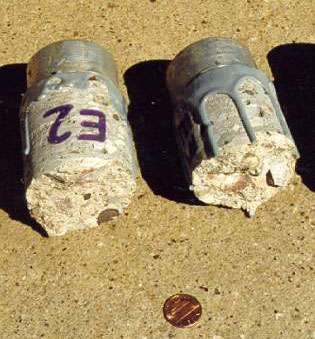
ASTM specifies non-shrink mortars be tested in a 2"x 2" metal cube ( ASTM C-109) instead of a 4"x 8" cylinder mold (ASTM C-39). Both test method specifications are testing compressive strength, but how is it decided whether to cast a cube specimen or a cylinder specimen?
Hydraulic mortars (including non-shrink grouts) are designed for precision load transfer applications, so they are designed with expansive properties. Non-shrink grouts are typically placed in confined forms where the expansive properties are limited to an upward direction. This results in maximum effective bearing area support and stronger physical properties. As a result of the non-shrink grout being restricted from expanding freely, it has now developed into a stronger and denser material.
Testing conditions that represent the application should produce representative test data. For example, if a non-shrink grout freely expanded in a non-restrictive mold material (such as plastic), the compressive strength test data would be low and would produce a less dense finished product. This could be a factor if "value-engineering" were used.
Traditional concrete is not designed with expansive properties. Therefore, a resistive mold material is not necessary. In fact, concrete will naturally undergo some shrinkage (generally about 1%) within the first 24 hours. Consequently, plastic or disposable cylinder molds (with dimensions of the hardened specimen that comply with ASTM C-39) are the standard mold material for concrete test specimens in use today.
In his book Properties of Concrete, Adam Neville says:
It is difficult to say which type of specimen, cylinder or cube is "better", but even in countries where cubes are the standard specimen, there seems to be a tendency, at least for research purposes to use cylinders rather than cubes. Cylinders are believed to give a greater uniformity of results for nominally similar specimens because their failure is less affected by the end restraint of the specimen; their strength is less influenced by the properties of the coarse aggregate used in the mix; and the stress distribution on horizontal planes in a cylinder is more uniform than on a specimen of square cross section. (594)
He goes on to say that cylinders are cast and tested in the same direction whereas for cubes the test is transverse.
Wednesday, May 19, 2010
Hot Weather Concreting

With summer in full force, it is important to understand how hot weather conditions affect concrete and how to prevent these adverse effects. Once concrete has been damaged by hot weather, it can never be fully restored.
What is considered "hot weather" in regards to concreting? According to ACI 305, "Hot Weather Concreting," hot weather is any combination of the following weather conditions: high ambient temperature, low relative humidity, solar radiation and/or wind.
Common problems/concerns that arise during these conditions include:
- Increased water demand
- Accelerated slump loss
- Placing and finishing difficulties resulting from accelerated set times
- Rapid drying causing increase in plastic shrinkage cracking
- Long term strength loss
- Potential for thermal cracking in massive structures
Precautionary measures can be taken to alleviate these effects:
- Moisten subgrades and forms so water wont be absorbed from the mix
- Prior to placing, cool aggregates and mixing water to reduce initial temperatures. Use sunshades, windbreaks and temporary covers, such as moistened burlap, over the surface to keep surface temperature down and hold in moisture. Consider fogging to preserve humid conditions.
- To retain moisture, make finishing easier, minimize shrinkage cracking and reduce water demand, use an evaporation retardant such as US SPEC Monofilom ER
- Cure concrete surfaces with US SPEC Maxcure Resin Clear or Maxcure Wax White when surfaces are hard enough to resist marring.
- Seal with a good quality sealer, such as Roca Seal or BRS-25, when concrete is fully cured.
Subscribe to:
Posts (Atom)