Tuesday, March 4, 2014

Tuesday, February 11, 2014
Bryan Smith Elected CSI Denver President
Bryan Smith, Technical Director at US MIX / US SPEC, has recently been elected President of The Construction Specification’s Institute (CSI) Denver Chapter for fiscal year 2014. Bryan has been active in CSI on both a local and national level since 2008 and served as Vice President last year.
CSI’s mission is “to advance building information management and education of project teams to improve facility performance”. As President, Bryan is responsible for the day-to-day responsibilities for the institute and is the point person and final decision maker. However, Bryan emphasizes that he encourages the board to work together and make decisions as a group. The board meets monthly and focuses on increasing membership and utilization of the great resources they have available. Bryan says, “what CSI offers is the ability to advance the quality of construction through documentation”.
CSI offers certification exam for CDT, CCS and CCCA and hold study courses twice a year. There is also an “Academic Task Group” that works with local universities to present CSI to Construction Management and Architectural departments and expose them to construction documentation and specification organization.
In addition, CSI has organized several popular job site tours including a tour of Colorado State University’s new student building and a large project where participants could visit at various phases of construction to see how the process evolves.
According to Bryan, his involvement with CSI “ensures that we are a leader in the construction specification industry.” It provides US SPEC with exposure to the specifications community and provides numerous networking opportunities both regionally and nationally.
CSI’s mission is “to advance building information management and education of project teams to improve facility performance”. As President, Bryan is responsible for the day-to-day responsibilities for the institute and is the point person and final decision maker. However, Bryan emphasizes that he encourages the board to work together and make decisions as a group. The board meets monthly and focuses on increasing membership and utilization of the great resources they have available. Bryan says, “what CSI offers is the ability to advance the quality of construction through documentation”.
CSI offers certification exam for CDT, CCS and CCCA and hold study courses twice a year. There is also an “Academic Task Group” that works with local universities to present CSI to Construction Management and Architectural departments and expose them to construction documentation and specification organization.
In addition, CSI has organized several popular job site tours including a tour of Colorado State University’s new student building and a large project where participants could visit at various phases of construction to see how the process evolves.
According to Bryan, his involvement with CSI “ensures that we are a leader in the construction specification industry.” It provides US SPEC with exposure to the specifications community and provides numerous networking opportunities both regionally and nationally.
Thursday, January 9, 2014
US SPEC Joins Post-Tensioning Institute
US SPEC has joined the Post-Tensioning Institute (PTI), an organization dedicated to advancing post-tensioning applications through marketing, education, research, teamwork and code development while advancing the quality, safety, efficiency, profitability, and use of post-tensioning systems.
Recognized as the worldwide authority on post-tensioning, PTI represents a community of businesses and professionals dedicated to expanding quality post-tensioning applications. Megan Lord, who is managing the development of US SPEC’s PT Grout program, says our membership with PTI “allows us to have a voice and be involved with a strong organization that is developing and shaping the PT industry.”
In addition, Bryan Smith, Technical Director, has been appointed as an Associate Member of M-55 Grouting Committee. Bryan says, “We joined PTI in accord with our own moral compass towards continual pursuit of quality and improvement – in every aspect of our business. We joined to participate and help improve the industry in any way we can.”
Thursday, August 15, 2013
US SPEC New Website Announcement

The updated product pages contain information about the complete US SPEC product line. With easy-to-use product calculators and instructional videos, it is easier than ever to access information and find the products you need.
New features include "The Tool Box" which is designed as a gathering place of technical information, company newsletters, videos and photos - all designed to inform and educate our customers on US SPEC products.
We hope you enjoy browsing our new site and learning more about our products and company.
Friday, July 19, 2013
Friday, May 31, 2013
Wednesday, May 1, 2013
Standards and Specifications
A note from Bryan Smith, US SPEC Technical Director:
A quote I heard during this past Post-Tensioning Institute (PTI) Convention in Scottsdale, Arizona was “Those who show up make the rules” (ASPIRE magazine, William Nickas). In response to this quote, US SPEC participates in the development of standards and specifications with organizations such as ASBI, ASTM, CSI and ICRI to name a few.
As a manufacturer we are constantly presented with various specifications to comply with. We take our ability to meet these specifications very seriously and develop products to meet the most legitimate industry specifications and standards. This may be in the form of A/E specifications or DOT specifications. Regardless of what specifications we are faced with, one aspect generally remains consistent across the board - they are all different! Regional climate considerations are an understandable reason for some of these changes; however, most of the differences in specification requirements are due to lack of industry knowledge beyond each municipality’s governance.
One commendable effort being pursued by the post-tension industry is a joint initiative between state DOTs and the FHWA (U.S. Federal Highway Association). This initiative is taking place in the PTI M-50/ASBI joint task group. Meetings will be held at PTI and ASBI conventions. The objective of this committee is to bring all state DOTs together in an effort to develop a single specification for post-tension grouting for adoption nationwide. The current guide specification produced by PTI (M-55) is constantly improving and serves as a progressively rigid document to use as the foundation for this effort.
TXDOT is the first state DOT we are aware of who is planning to adopt PTI M-55 as their chief PT grouting specification. With more than 53,000 bridges statewide (more than any other state) and more than 600 post-tensioned bridges, it seems fitting they are on board with advancing this effort. What is their reasoning? Life-cycle cost savings!
The more information we share in community through similar experiences the more we can learn from each other and improve our systems, technologies, materials and the overall built environment in which we live and operate.
ASBI: American Segmental Bridge Institute
ASTM: American Society for Testing and Materials
CSI: Construction Specifications Institute
ICRI: International Concrete Repair Institute
A quote I heard during this past Post-Tensioning Institute (PTI) Convention in Scottsdale, Arizona was “Those who show up make the rules” (ASPIRE magazine, William Nickas). In response to this quote, US SPEC participates in the development of standards and specifications with organizations such as ASBI, ASTM, CSI and ICRI to name a few.
As a manufacturer we are constantly presented with various specifications to comply with. We take our ability to meet these specifications very seriously and develop products to meet the most legitimate industry specifications and standards. This may be in the form of A/E specifications or DOT specifications. Regardless of what specifications we are faced with, one aspect generally remains consistent across the board - they are all different! Regional climate considerations are an understandable reason for some of these changes; however, most of the differences in specification requirements are due to lack of industry knowledge beyond each municipality’s governance.
One commendable effort being pursued by the post-tension industry is a joint initiative between state DOTs and the FHWA (U.S. Federal Highway Association). This initiative is taking place in the PTI M-50/ASBI joint task group. Meetings will be held at PTI and ASBI conventions. The objective of this committee is to bring all state DOTs together in an effort to develop a single specification for post-tension grouting for adoption nationwide. The current guide specification produced by PTI (M-55) is constantly improving and serves as a progressively rigid document to use as the foundation for this effort.
TXDOT is the first state DOT we are aware of who is planning to adopt PTI M-55 as their chief PT grouting specification. With more than 53,000 bridges statewide (more than any other state) and more than 600 post-tensioned bridges, it seems fitting they are on board with advancing this effort. What is their reasoning? Life-cycle cost savings!
The more information we share in community through similar experiences the more we can learn from each other and improve our systems, technologies, materials and the overall built environment in which we live and operate.
ASBI: American Segmental Bridge Institute
ASTM: American Society for Testing and Materials
CSI: Construction Specifications Institute
ICRI: International Concrete Repair Institute
Friday, April 19, 2013
US SPEC Quickset - New Video
US SPEC is currently filming several new videos demonstrating some of our core products. We just added a video of our US SPEC Quickset to our YouTube channel. Check it out below! For all our videos, visit our YouTube channel here.
Thursday, December 20, 2012
Cold Weather and Liquid Cures and Sealers
With winter temperatures setting in, it is important to take precautions with your liquid and water based products including cures, sealers and bonding agents. Products with 50% water composition or greater are prone to freezing. Freezing changes the composition of a material, rendering it less effective when it thaws. Be sure to store these products in a heated warehouse or other warm, dry place during cold winter months. Do not store products outside when freezing temperatures are possible, and please caution your customers to do the same. Also, when placing most of these products, it is wise to ensure the application area is not exposed to freezing temperatures 24 hours prior to and 72 hours after application.
If you are concerned about freezing temperatures, solvent based products can offer a good solution. Solvent based products can withstand cold temperatures without freezing. However, these products must be brought to a minimum temperature before they are applied. Remember to follow ACI procedures for cold weather concreting and do not hesitate to contact your US SPEC representative with any questions or concerns.
Thursday, April 12, 2012
US SPEC Involved in New ASTM Standard for PT Grouts
US SPEC’s Technical Director, Bryan Smith, is an active member of several ASTM committees including a new committee developing an important new standardized ASTM test method for determining bleed-stability in post-tension grouts. Material manufacturers, grouting contractors, specifiers, DOT’s and testing laboratories will be the primary users of ASTM C1741.
ASTM C1741, Test Method for Bleed Stability of Cementitious Post-Tensioning Tendon Grout, is under the jurisdiction of Subcommittee C09.41 on Hydraulic Cement Grouts, part of ASTM International Committee C09 on Concrete and Concrete Aggregates.
Bryan Smith says, “bleed stability is a critical characteristic regarding the intended use of grout for PT cable protection, aiding safety by way of protection through complete cable encapsulation. Bleed facilitates reduced performance and increases potential for voids and corrosion.”
ASTM C1741, Test Method for Bleed Stability of Cementitious Post-Tensioning Tendon Grout, is under the jurisdiction of Subcommittee C09.41 on Hydraulic Cement Grouts, part of ASTM International Committee C09 on Concrete and Concrete Aggregates.
Bryan Smith says, “bleed stability is a critical characteristic regarding the intended use of grout for PT cable protection, aiding safety by way of protection through complete cable encapsulation. Bleed facilitates reduced performance and increases potential for voids and corrosion.”
Friday, December 30, 2011
US SPEC and the American Segmental Bridge Association
US SPEC is pleased to announce we have joined the American Segmental Bridge Institute (ASBI) as a Materials Supplier. ASBI is a nonprofit organization that provides a forum where owners, designers, constructors, and suppliers can meet to further refine current design, construction and construction management procedures, and evolve new techniques that will advance the quality and use of concrete segmental bridges.
ASBI is a focal point for the development of technical information for design and construction of segmental concrete bridges in the U.S. and countries around the world. Segmental bridges are now a multi-billion dollar market in the U.S. with ASBI providing educational programs and publications in response to industry needs.
Technical Director Bryan Smith says our membership in ASBI is “not solely to show our support for the bridge construction industry, but also to work in community with our customers. Joining ASBI is exciting for us because it offers an opportunity to be a part of a larger community with shared interests. It allow us to learn and become better at what we do best - serve our customers with a quality foot forward.”
Additionally, as of May 2012, two of our team members will have completed the ASBI Grouting Certification Program.
ASBI is a focal point for the development of technical information for design and construction of segmental concrete bridges in the U.S. and countries around the world. Segmental bridges are now a multi-billion dollar market in the U.S. with ASBI providing educational programs and publications in response to industry needs.
Technical Director Bryan Smith says our membership in ASBI is “not solely to show our support for the bridge construction industry, but also to work in community with our customers. Joining ASBI is exciting for us because it offers an opportunity to be a part of a larger community with shared interests. It allow us to learn and become better at what we do best - serve our customers with a quality foot forward.”
Additionally, as of May 2012, two of our team members will have completed the ASBI Grouting Certification Program.
Friday, May 21, 2010
Freeze Thaw and ASTM C-672

Durability is the ability of concrete to resist weathering action, chemical attack and abrasion while maintaining its desired engineering properties. How durable concrete products need to be depends on the kind of environment they will be exposed to. As cold weather approaches, concepts like freeze-thaw and resistance to deicing salts become important to understand. When water freezes, it expands 9%. As the water in moist concrete freezes, it produces pressure in the pores of concrete. If this pressure exceeds the tensile strength, the cavity will dilate and rupture. Successive freeze-thaw cycles will then eventually cause expansion and cracking, scaling, and/or crumbling of the concrete. Deicing chemicals, used for snow and ice removal, can aggravate freeze-thaw deterioration. Therefore, when using cement products, such as patching materials, on concrete roadways it is important that these materials have a strong resistance to the effects of these harsh conditions and chemicals.
ASTM C-672 is the standard test method for Scaling Resistance of Concrete Surface Exposed to Deicing Chemicals. It covers the determination of the resistance to scaling (local flaking or peeling of a finished concrete surface) of a horizontal concrete surface exposed to freeze-thaw cycles in the presence of deicing chemicals. The test is intended for use in evaluating this surface resistance qualitatively by visual examination.
How is the test performed? Specimens are placed in a solution of calcium chloride and water with a concentration that imitates deicing salts; they are then placed alternatively in a freezing environment and a room temperature environment. This cycle is repeated daily and the surface is flushed off thoroughly at the end of every 5 cycles to visually examine the surface. Generally, 50 cycles is sufficient to evaluate the surface and the condition of the surface is reported using a rating scale from 0 to 5; meaning there is no scaling present and 5 indicating there is severe scaling (coarse aggregate is visible over the entire surface). Quality patching products, like US SPEC Transpatch, should be displaying scaling resistance after this 50 cycle test.
Cold Weather: Installation of Epoxies

Procedural adjustments should be made when setting and grouting epoxies during periods of cold temperatures. Cold epoxy liquids, along with air and surface temperatures, can cause workability problems and slow the curing process. Observe the following recommendations for best results:
- Keep epoxy liquids stored at room temperature (70 degrees) for 12 to 24 hours before use. Cold liquids can be warmed by placing unopened containers in warm water.
- Epoxy liquids are freeze/thaw stable. Frozen liquids can be thawed at room temperature or by placing in warm water.
- Cold temperature will make epoxy stiffer to work with and extend set time. Mixing, spreading, grouting, and cleanup will require additional attention if done in cooler temperatures. Completed work should be protected from foot traffic for longer periods. A floor grouted at 50 degrees should be protected at least 32 hours.
- For best results, surface temperatures should be between 60 degrees and 90 degrees.
- Consider using these products specifically designed for use in very cold weather. US SPEC Gelbond Sub-Zero is designed to gun at -15 degrees.
- Consult manufacturer's recommendation for epoxy usage when optimum conditions do not exist.
Cubes vs. Cylinders: Mold Materials and Shapes
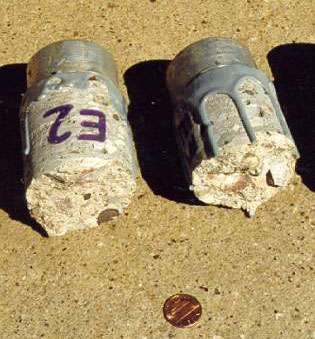
ASTM specifies non-shrink mortars be tested in a 2"x 2" metal cube ( ASTM C-109) instead of a 4"x 8" cylinder mold (ASTM C-39). Both test method specifications are testing compressive strength, but how is it decided whether to cast a cube specimen or a cylinder specimen?
Hydraulic mortars (including non-shrink grouts) are designed for precision load transfer applications, so they are designed with expansive properties. Non-shrink grouts are typically placed in confined forms where the expansive properties are limited to an upward direction. This results in maximum effective bearing area support and stronger physical properties. As a result of the non-shrink grout being restricted from expanding freely, it has now developed into a stronger and denser material.
Testing conditions that represent the application should produce representative test data. For example, if a non-shrink grout freely expanded in a non-restrictive mold material (such as plastic), the compressive strength test data would be low and would produce a less dense finished product. This could be a factor if "value-engineering" were used.
Traditional concrete is not designed with expansive properties. Therefore, a resistive mold material is not necessary. In fact, concrete will naturally undergo some shrinkage (generally about 1%) within the first 24 hours. Consequently, plastic or disposable cylinder molds (with dimensions of the hardened specimen that comply with ASTM C-39) are the standard mold material for concrete test specimens in use today.
In his book Properties of Concrete, Adam Neville says:
It is difficult to say which type of specimen, cylinder or cube is "better", but even in countries where cubes are the standard specimen, there seems to be a tendency, at least for research purposes to use cylinders rather than cubes. Cylinders are believed to give a greater uniformity of results for nominally similar specimens because their failure is less affected by the end restraint of the specimen; their strength is less influenced by the properties of the coarse aggregate used in the mix; and the stress distribution on horizontal planes in a cylinder is more uniform than on a specimen of square cross section. (594)
He goes on to say that cylinders are cast and tested in the same direction whereas for cubes the test is transverse.
Wednesday, May 19, 2010
Hot Weather Concreting

With summer in full force, it is important to understand how hot weather conditions affect concrete and how to prevent these adverse effects. Once concrete has been damaged by hot weather, it can never be fully restored.
What is considered "hot weather" in regards to concreting? According to ACI 305, "Hot Weather Concreting," hot weather is any combination of the following weather conditions: high ambient temperature, low relative humidity, solar radiation and/or wind.
Common problems/concerns that arise during these conditions include:
- Increased water demand
- Accelerated slump loss
- Placing and finishing difficulties resulting from accelerated set times
- Rapid drying causing increase in plastic shrinkage cracking
- Long term strength loss
- Potential for thermal cracking in massive structures
Precautionary measures can be taken to alleviate these effects:
- Moisten subgrades and forms so water wont be absorbed from the mix
- Prior to placing, cool aggregates and mixing water to reduce initial temperatures. Use sunshades, windbreaks and temporary covers, such as moistened burlap, over the surface to keep surface temperature down and hold in moisture. Consider fogging to preserve humid conditions.
- To retain moisture, make finishing easier, minimize shrinkage cracking and reduce water demand, use an evaporation retardant such as US SPEC Monofilom ER
- Cure concrete surfaces with US SPEC Maxcure Resin Clear or Maxcure Wax White when surfaces are hard enough to resist marring.
- Seal with a good quality sealer, such as Roca Seal or BRS-25, when concrete is fully cured.
Earn LEED Points Using Concrete

The LEED rating system was devised by the U.S. Green Building Council (USGBC) to evaluate the environmental performance of a building and encourage market transformation toward sustainable design. There are several LEED rating systems for various project types including LEED for New Construction, LEED for Schools, LEED for Commercial Interiors and LEED for Homes.
Reason concrete can be used to build green include:
1.Concrete creates sustainable sites
2.Concrete enhances energy performance
3.Concrete contains recycled materials
4.Concrete is typically manufactured locally
5.Concrete builds durable structures
Following are just a few examples of how concrete can be used to increase the number of points awarded to building in the LEED system.
Brownfield Redevelopment (SS Credit 3)
Concrete can be used to solidify and stabilize contaminated soils and reduce leachate concentrations to below regulatory levels.
Site Development: Protect or Restore Habitat (SS Credit 5.1) & Maximize Open Space (SS Credit 5.2)
Concrete parking garages within buildings can limit site disturbance and restore previously developed sites. Parking garages within buildings help maintain natural areas that would otherwise be consumed by paved parking. This can contribute to SS Credit 5.1
Concrete parking garages can also help reduce the footprint of the development. Garages within buildings reduce the project's paved parking areas. This can contribute to SS Credit 5.2
Heat Island Effect: Nonroof (SS Credit 7.1)
This credit requires a combination of various strategies for 50% of the site hardscape (including roads, sidewalks, courtyards and parking lots) that will reduce heat islands or thermal gradient differences between developed and undeveloped areas. This can be met by using light colored concrete rather than asphalt for 50% of the impervious surfaces. This credit can also be met by placing a minimum of 50% of parking spaces under cover.
Optimize Energy Performance (EA Credit 1)
Studies show that using concrete walls that are insulated to exceed minimum code requirements by a modest amount can contribute to earning 1 to 3 points, depending on the building type, orientation and climate.
Low-Emitting Materials (IEQ Credit 4.2)
Credits can be earned by using low VOC products which may include products used specifically with concrete. This includes form releases, cures and sealers. Several US SPEC products in each of the above categories meet this requirement.
These are just a few examples of how building with concrete can support a project seeking LEED certification. For more information on the LEED program and project certification, please visit the USGBC web site, http://www.usgbc.org/.
Tuesday, May 18, 2010
Hot Weather Structural Grouting

Grout can be safely placed through the summer months in hot, dry climate's if certain precautions are taken. Hot weather is defined by the American Concrete Institute as, "a period when for more than 3 successive days the mean daily temperature is above 90 degrees. In order to apply grout in hot weather conditions, the following precautions must be followed:
1.Normal cement storage and handling practices should be observed. Store material should be observed. Store material indoors or in the shade with the plastic shrink-wrap removed. Use water cooled with ice, if needed. A fine screen can be used to filter out the ice when pouring the mix water.
2.Prior to grouting, it is crucial to keep the grout base saturated with water (SSD) for 24 hours in advance. The metal base plate should be cooled, and this can be accomplished with wet burlap or towels. If possible, create shade for the area to be grouted.
3.Begin grouting during the early part of the day to take advantage of the cooler temperatures.
4.During pumping applications, keep the pumping lines cool, especially with long lines. This can be accomplished with wet towels or rags. Use as little line as possible. Also, prior to priming the pump with cement slurry, pumping cold water through the lines will cool the lines down.
5.Mixing water shall be kept at a temperature of 30 degrees-50 degrees.
6.Hot weather will reduce the working time with the grout and smaller batches may be required. The compressive strength of the grout may be tested according to ASTM C-109. Use a surface thermometer to monitor temperature conditions of the grout.
US SPEC Non-shrink Grouts are formulated to meet the requirements of ASTM C-1107, CRD C-621 Corps of Engineers, and various DOT Specifications. US SPEC grouts include:
FS Grouting Special- Fast-setting, non-shrink precision grout
GP Grout-High strength, all purpose construction grout, plastic to fluid
MP Grout- High flow, high strength precision grout, damp pack to fluid
NA Grout-Aggregate free, super high flow, tendon grout
Premium Grout-High performance, high strength, high flow precision grout
Sustainable Concrete Through Curing

Sustainable is defined as "capable of being continued with minimal long-term effect on the environment." Concrete has been used as a building material for over 3000 years and is one of the world's most sustainable building materials. It is continually undergoing postmodern developments due to its versatility and lack of limitations.
A primary building block toward sustainable concrete is proper curing technique. Curing's influence on the properties of hardened concrete include durability, strength, water-tightness, abrasion resistance, volume stability and resistance to freeze/thaw.
There is a chemical reaction that occurs when you mix water and cement. It is a two stage process:
1.The first stage happens quickly when concrete forms a liquid to a solid state, usually within four hours.
2.The second stage begins as reaction slows down, but crystals continue to grow and the concrete gets stronger. This is where curing comes in; for this reaction to continue (and concrete to continue gaining strength), concrete needs optimal water retention.
There are several ways to stop water from leaving freshly poured concrete. We frequently see tarps covering slabs, often secured by duct tape and concrete chunks. These tarps will often blow loose during a strong wind gust. While this may seem to be an easy and economical solution, it is important to focus on the life-cycle costs of maintaining the structures we have worked hard to design.
One of the simplest and most effective methods to cure concrete is by using a curing compound. Curing compounds are typically made from waxes, acrylics and various resins. These cures form a watertight film that prevents water from evaporating from the concrete. The key is to apply the curing compound when the concrete product is damp but without standing bleed water.
Dissipating resins are among the most popular cure because they chemically break down over time when exposed to traffic, weather and ultraviolet light. These cures allow easy removal before a subsequent floor coating or covering is installed. Some curing compounds contain a white pigment to reflect sunlight and keep outdoor concrete cooler. The pigment also allows for a visual inspection of coverage.
Generally, curing compounds do not provide any long-term protection or enhanced appearance to concrete. "Cure & Seals" are used in the same ways as curing compounds, but have the added benefit of imparting a lasting seal on the concrete surface. These products can be reapplied when traffic or weather wear away the protective seal and diminish its effectiveness.
Shrinkage

As concrete cures, shrinkage is inevitable. This shrinkage results in a volume change or deformation of the concrete. The paste component of a concrete mix is often the target of shrinkage as it is soft, porous and absorbent. The paste component shrinks as much as 1% of its initial volume on its first day after casting.
Several factors contribute to why cement paste shrinks and the two most common types of shrinkage are known as drying shrinkage and plastic shrinkage. Plastic shrinkage occurs while concrete is in the plastic state and results from surface evaporation due to environmental conditions. Drying shrinkage forms from a loss of water that occurs when the rate of evaporation of the concrete exceeds the rate of bleeding and happens after concrete has reached its initial set. While drying shrinkage is caused by environmental factors as well, concrete material factors and size of application area (surface area to volume ration) also play a role. Typically, this type of shrinkage is more of a problem during warm weather months and causes "drying shrinkage cracks." If the concrete is reinforced, the cracks may produce a direct path for chloride ions to reach reinforcing steel which can ultimately cause further cracking and other problems such as spalling and delamination of concrete.
Whichever reaction takes place, there are measures that can be taken to help reduce the amount of shrinkage that occurs. One measure is to use a larger size of aggregate when possible, since it would require less paste component. Using wind breaks, sunshades and evaporation reducers followed by a membrane forming curing compound will also control the rate of drying of the concrete. Curing allows the concrete to retain moisture so that it continues to gain strength and delays drying shrinkage until the concrete is strong enough to resist shrinkage cracking.
US SPEC has a line of concrete curing and sealing products available that reduce the drying rate of concrete. The US SPEC team can help answer any questions on shrinkage, and assist in recommending ways to prevent it.
Non-Destructive Concrete Testing

Not meeting strengths? It may not happen today or tomorrow, but chances are at some point in time your concrete or cementitious repair may not reach the design compressive within the target date. What if the material has already set or has been hydrating for a week? Usually coring is not an option and replacement is a last resort. So, what are the other options?
Non-destructive testing is a great place to start a low-strength investigation for an in-place concrete structure. One of the simplest and most readily available forms of non-destructive testing is with a device known as a rebound hammer, also referred to as a Schmidt or Swiss hammer.
A rebound hammer is a spring-loaded, hand-held device that is used to obtain compressive strength data for already hardened concrete or other cementitious structures. The device is easy to use, and you can obtain an in-place compressive strength estimates in minutes. Conversions are completed by referencing a conversion chart typically tagged in metal to the device itself. Digital rebound hammers are also available which are more costly; however, they will convert automatically.
If you don't have immediate access to a rebound hammer your local ready-mix supplier should. Ensure that the rebound hammer has been calibrated within the year and testing practices are in compliance with ASTM C 805. Hopefully the material in question is found to be structurally sound, and the investigating ends shortly after rebound testing is performed.
When considering non-destructive testing, be sure to ask the question, "what is the function of the structure in question?" This will help determine the magnitude and precision of testing necessary. The answer will provide a platform for discussion in determining the appropriate testing needs. There must be a proper diagnosis prior to rehabilitation. It is not economical to spend thousands of dollars on testing if the tests do not supply the data you need.
For example, the rebound hammer is not sufficient for every investigation; however, it is a good starting point. The rebound hammer is 70-80% accurate when testing lab specimens and slightly less accurate when estimating in situ structures.
Everything has its place, including test methods; ASTM and other governing specification institutes exist because testing has to be specific. Should an investigation require additional test data, there are alternative methods of non-destructive testing to consider. These include The Windsor Probe, ultrasonic testing, rebar locators, corrosion testing, bond testing, moisture testing and anchor testing.
Subscribe to:
Posts (Atom)